José Ricardo F. Bezerra
Introduction
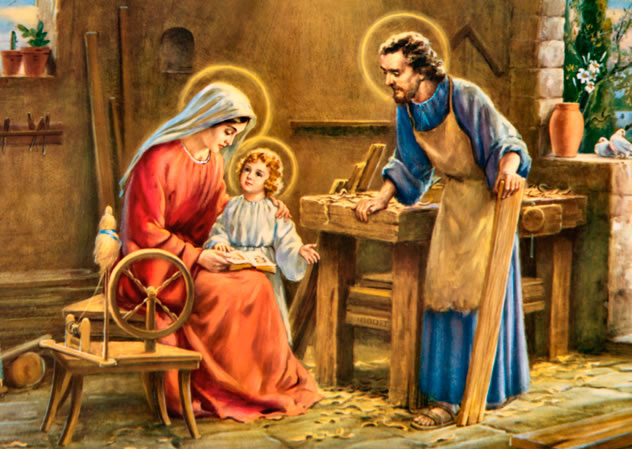
The Feast of the Holy Family places us before a concrete mystery: God chose to save the world not on the margins of family life, but within it. Jesus is not born already in glory, but into a family; he does not grow up in isolation, but within a history marked by work, displacement, danger, and difficult decisions. The Gospel of Matthew (2:13–15, 19–23) shows us a family under threat, guided by the voice of God and sustained by the silent obedience of Saint Joseph.
In this Gospel, we do not find long speeches or spectacular gestures. We find listening, readiness, and trust. The Holy Family teaches us that holiness most often passes through the ordinary course of life and fidelity in concrete choices. In our podcast (https://www.youtube.com/watch?v=h1IsRkXhEVE), we propose seven points to help with personal prayer using this Gospel.
- The angel of the Lord
The Gospel begins with God’s initiative: the angel of the Lord appears to Joseph in a dream. God speaks, guides, and warns. But he speaks in a way that requires faith. The angel’s words do not eliminate risk or resolve every doubt. They ask for interior listening and availability to act. Joseph does not receive guarantees; he receives a mission. In the spiritual life it is the same: God guides us, but does not spare us the responsibility of responding.
The Lord continues to act in each person’s history, guiding, guarding, and warning. The question is not whether God speaks, but whether we are attentive to his voice and willing to obey when it takes us out of our comfort zone.
- Joseph
Saint Joseph occupies a central place in this Gospel. He listens and acts. He does not argue, delay, or relativize. He rises in the night, takes the child and his mother, and departs. His obedience is not born of naivety, but of deep trust in God. Joseph accepts the task of leading those greater than himself: Jesus, the Son of God, and Mary, the Mother of the Lord.
Here lies a great lesson for all who exercise any form of authority. Joseph governs by serving, protects by obeying, and leads by placing himself in the background. He shows us that true authority, from the Latin auctoritas, to make grow, seeks the good of the other, is born of listening to God, and is sustained by responsibility embraced with love.
- The child and his mother
Matthew twice uses the expression “the child and his mother” (Mt 2:14, 20). The center is Jesus. Everything revolves around him. The family exists to guard, protect, and serve him. The child’s fragility reveals how God chose to enter history: without imposing himself, entrusting himself to human care.
Mary appears here in silence, but her presence is decisive. She submits to Joseph, walks, trusts, and accompanies. Mary’s motherhood is not only biological, but deeply spiritual: she welcomes the mystery and remains faithful, even when she does not understand everything.
To contemplate the child Jesus is to learn to recognize God in fragility, dependence, and simplicity.
- Egypt
The flight into Egypt inserts Jesus into the history of his people (cf. Hos 11:1; Mt 2:15). He retraces Israel’s path, experiences exile and the condition of a foreigner. The Holy Family knows displacement, insecurity, and waiting. This is not a brief journey, but a prolonged stay, marked by silence and trust in divine Providence.
Egypt reminds us that God often leads us along paths we would not choose. Even so, he remains faithful. Salvation does not happen outside concrete history, but within it, with its pains and uncertainties.
- Herod
King Herod represents power that fears losing control. He sees Jesus as a threat and responds with violence (cf. Mt 2:16–18). The Gospel invites us to recognize that the spirit of Herod does not belong only to the past. Whenever we reject God’s lordship to preserve our own interests, something of Herod appears in us.
The contrast is clear: while Herod protects his throne at the cost of innocent lives, Joseph protects the Child by placing himself at risk. Two opposite ways of exercising power and making choices.
- The return to the land of Israel
When the immediate danger passes (cf. Mt 2:19), Joseph receives new guidance: it is time to return. The spiritual life is not static. God leads us through stages. Joseph obeys again, but must discern. When he learns that Archelaus reigns in Judea (cf. Mt 2:22), he is afraid and once more listens to the Lord’s direction.
This return teaches that obeying God does not dispense with prudent discernment. Trust does not eliminate the responsible use of intelligence. Joseph chooses Nazareth, a simple place, far from centers of power, where Jesus will grow in hidden life.
- The Nazarene
“He shall be called a Nazarene” (Mt 2:23b). This closing line of the Gospel raises a difficult question for exegetes of all times: to which prophecy did the evangelist refer? In The Infancy of Jesus, Pope Benedict XVI explains that Jesus is the true consecrated one (nazir) of the Father, the one totally set apart for God. He is also, in a preeminent way, the shoot (nezer) from the stump of Jesse upon whom the Spirit of the Lord rests (cf. Is 11:1–9). Thus Matthew completes Isaiah’s messianic trilogy: the virgin who gives birth to Emmanuel (cf. Is 7:14; Mt 1:23), the people who walked in darkness (cf. Is 9:1; Mt 4:15–16), and the continuation that speaks of the child given to us, Wonderful Counselor, Mighty God, Prince of Peace (cf. Is 9:5).
Jesus’ consecration is manifested in the humility of Nazareth. The Son of God chooses to be known by the small place where he lived. Nazareth is not mentioned in the Old Testament as an important city; on the contrary, it was a despised place (cf. Jn 1:46). To call Jesus a “Nazarene” is to link him to smallness, hiddenness, and simple life, yet one deeply rooted in the lineage of his ancestors. Thus, the Holy Family teaches us that God reveals himself in hiddenness and that holiness blossoms where it is least expected.
Practical conclusions
The Feast of the Holy Family invites us to review how we live our faith in daily life. God acts in the concrete history of families, even when it is marked by difficulties, fears, and hard decisions.
Let us learn from Joseph to listen to the voice of God and his messengers and to obey; from Mary, to trust and to be docile to her husband’s guidance; and from Jesus, to embrace the Father’s will in the simplicity of daily life, being submissive (cf. Lk 2:51) to those whom the Father chose.
May our families become places of listening, care, protection of life, and total trust in God.
Steps of Lectio Divina
- Reading (lectio): Read Matthew 2:13–15, 19–23 slowly and attentively. Observe the verbs of action: rise, seek, take, flee, return, dwell.
- Meditation (meditatio): Where has God been asking me for trust and obedience? What fears do I need to entrust to him?
- Prayer (oratio): Pray: “Lord, teach me to listen to your voice and to trust your guidance, even when the path is difficult and uncertain.”
- Contemplation (contemplatio): Remain in silence before the Holy Family. Contemplate the peace that is born of obedience to God.
- Action (actio): This week, carry out a concrete gesture of care and responsibility toward someone in your family, inspired by Saint Joseph.
Until next week.
Shalom!