José Ricardo Bezerra and Felipe Bezerra
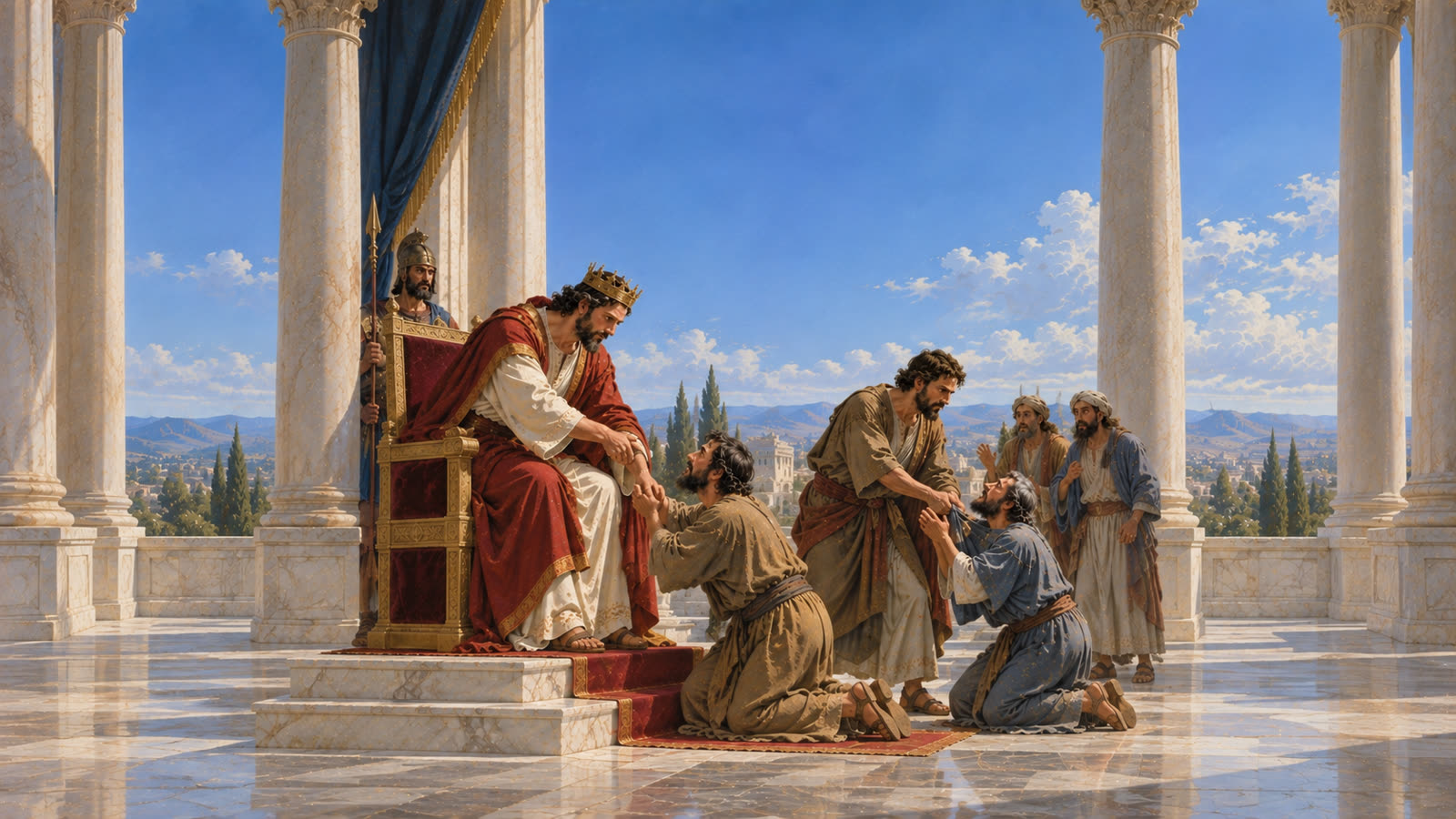
On this 25th Sunday in Ordinary Time, the Gospel (Mt 20:1-16a) presents us with the parable of the workers in the vineyard. A landowner goes out at dawn to hire laborers and goes out again at nine o’clock, at noon, at three and at five in the afternoon. At the end of the day, he orders that all of them be paid the same daily wage, beginning with the last. Those who worked from early morning grumble, and he answers: “My friend, I am not cheating you” (Mt 20:13).
The parable dismantles an expectation of ours, just as happened last week with Peter’s question about forgiving (only up to) seven times (cf. Mt 18:21-22). We expected an accounting, and God answers with generosity. He is unjust to no one: he fulfills exactly what he agreed. But his goodness goes beyond what our measure is able to calculate. As always, we have chosen five points for your meditation and prayer, which we share in the podcast: https://youtu.be/IHamHtoU5bs (with subtitles in your language).
1. The landowner who goes out at dawn
“The kingdom of heaven is like a landowner who went out at dawn to hire laborers for his vineyard” (Mt 20:1).
The parable begins with the landowner, and it is on him that Jesus wants us to fix our gaze. He himself says what the comparison is about: the kingdom of heaven is like this man who goes out. The vineyard is an image that runs through the Old Testament to speak of the people of God and of the Lord’s care for them (cf. Is 5:1-7; Ps 80:9-16).
In the parable, the landowner goes out because he needs workers in his vineyard. God does not need us. Paraphrasing St. Augustine, it is often said that he had no need of us and yet freely willed to associate us with his work (cf. CCC 306-307). For this reason the call is not first of all to produce or to do something, but to be with him: the Lord calls his own “to be with him” and then to send them out (cf. Mk 3:14).
A traditional reading applies these departures at different hours to the ages of life, from youth to old age; other Fathers of the Church relate them to the stages of salvation history and to the calling of the nations. It applies, therefore, to vocations to the priesthood and to consecrated life, and also to the simplest parish life: setting out the chairs, cleaning the church, serving in whatever is needed. It holds as well for the life of prayer, where the Lord is always going out to meet us. St. Teresa of Jesus, in “The Interior Castle,” describes the soul that has the Lord within its own heart while it lives outside itself. St. Augustine had this experience and left it in writing in his book “Confessions”: he was seeking God in outward things, and God was within him. Hence the line that has remained: “Late have I loved you, O Beauty so ancient and so new, late have I loved you” (Confessions X, 27).
2. The other departures: where are we?
“Going out about nine o’clock, the landowner saw others standing idle in the marketplace” (Mt 20:3).
In the departures that follow, the parable shows those who were already working and those who were still standing in the marketplace, including the ones who were called only at the last hour. The question it hands back to us is simple: where are we? Have we already been called, and are we working? Are we standing still, waiting? Or have we not even come near the marketplace?
Faced with the call, the excuse comes easily: I cannot sing, I do not know how to organize anything, I am no good for that. St. Paul answers with the image of the body: the foot cannot say “Because I am not a hand I do not belong to the body,” nor can the ear say that it is not an eye (cf. 1 Cor 12:14-21). No one is dispensable and no service is too small. The Vineyard is large, and there is room for each one to do his part.
The last ones hired say to the landowner: “Because no one has hired us” (Mt 20:7). It may be an excuse, and it may be the truth. Perhaps someone was distracted in the marketplace, chatting, and did not notice the landowner passing by and calling. So the question remains for us: are we attentive enough to hear when the Lord calls?
3. The payment that begins with the last
“Summon the laborers and give them their pay, beginning with the last and ending with the first” (Mt 20:8).
The order of payment, beginning with the last, is deliberate. If the landowner had started by paying the first, they would have received their wage and gone away without seeing anything. He wants his goodness, however, to be seen by everyone. The daily wage of the parable, the denarius, was a day’s pay agreed upon beforehand with the first workers, and it corresponded to one day’s livelihood.
The same God who “makes his sun rise on the bad and the good, and causes rain to fall on the just and the unjust” (Mt 5:45) will also “repay each according to his conduct” (Mt 16:27; cf. Ps 62:13; Rom 2:6). And the parable shows that this justice is never violated: no one receives less than what was agreed, but God’s goodness goes beyond the calculation, and mercy “triumphs over judgment” (Jas 2:13).
The difficulty is not in the concept, it is in us. We keep measuring love on our own scales: if I do more, I should receive more; if the other did less, he should receive less. St. Thomas Aquinas, taking up an ancient definition, says that to love is to will the good of the other (cf. Summa Theologiae I-II, q. 26, a. 4). When I am good to someone so that this person will be good to me, that is not yet love. St. John says that “God is love” (1 Jn 4:8). He needs nothing in return: his generosity is entirely disinterested.
4. The grumbling of the first
“And on receiving it they grumbled against the landowner” (Mt 20:11).
Let us recall here the good qualities of these workers before judging their faults. They got up at dawn, accepted the work, bore the weariness and the heat of the whole day and did not complain while they worked. They agreed on the usual daily wage and received exactly what had been agreed.
The faults appear at the end: grumbling and envy. They accuse the landowner of injustice without reason, because his goodness toward the others took nothing away from what was theirs. Grumbling has accompanied the people of God since the time of the desert, when Israel complained even while receiving the manna (cf. Ex 16:2-3; Num 11:4-6). It is easy to stop recognizing the good we have received the moment we look at what someone else received.
The human side of the scene also comes in here. The parable does not describe each worker’s situation, but someone who lives on a daily wage depends on that day’s pay in order to eat the next day, and a payment proportional to the hours would leave the man hired at five in the afternoon with almost nothing to take home. The equality of the daily wage manifests the landowner’s generosity and care for the last, and not merely a tally of hours worked.
There is also the temptation to call God into question for being good to others. In the final discourses of the book of Job (cf. Job 38-41), God does not offer Job a detailed explanation of his suffering: he reveals the disproportion between divine wisdom and human understanding, and invites him to trust in the One who knows the beginning and the end of all things.
5. “Are you envious because I am generous?”
“Or am I not free to do as I wish with my own money? Are you envious because I am generous?” (Mt 20:15).
The parable ends with the landowner, as it were, “putting a finger on the wound.” The problem was not the money, it was the way of looking. God’s freedom in giving what is his is not arbitrariness: he is sovereign and he is good, and the gift he makes to one is not taken from another.
This gratuitousness has its highest point on the Cross. We had no way of paying our debt, and Christ paid for us, canceling “the bond against us, with its legal claims” (Col 2:14), while we were still sinners (cf. Rom 5:8). This is why the Lord calls us to filial love, which casts out servile fear (cf. 1 Jn 4:18). Holy fear of God remains a legitimate attitude and a gift of the Holy Spirit, because it is born of filial respect for the one who loves us.
May the landowner’s answer stay with us through the week. When envy wants to measure what someone else received, may we know how to give thanks for what we received freely, and may we rejoice in God’s goodness toward everyone.
Steps of the Lectio Divina
Lectio Divina is the prayerful reading of the Word of God. Set aside a time of silence, call upon the Holy Spirit and go calmly through these steps, praying with this Gospel yourself.
1. Reading (Lectio). What does the text say?
Gospel (Mt 20:1-16a)
Jesus told his disciples this parable: “The kingdom of heaven is like a landowner who went out at dawn to hire laborers for his vineyard. After agreeing with them for the usual daily wage, he sent them into his vineyard. Going out about nine o’clock, the landowner saw others standing idle in the marketplace, and he said to them, ‘You too go into my vineyard, and I will give you what is just.’ So they went off. And he went out again around noon, and around three o’clock, and did likewise. Going out about five o’clock, the landowner found others standing around, and said to them, ‘Why do you stand here idle all day?’ They answered, ‘Because no one has hired us.’ He said to them, ‘You too go into my vineyard.’ When it was evening the owner of the vineyard said to his foreman, ‘Summon the laborers and give them their pay, beginning with the last and ending with the first.’ When those who had started about five o’clock came, each received the usual daily wage. So when the first came, they thought that they would receive more, but each of them also got the usual wage. And on receiving it they grumbled against the landowner, saying, ‘These last ones worked only one hour, and you have made them equal to us, who bore the day’s burden and the heat.’ He said to one of them in reply, ‘My friend, I am not cheating you. Did you not agree with me for the usual daily wage? Take what is yours and go. What if I wish to give this last one the same as you? Or am I not free to do as I wish with my own money? Are you envious because I am generous?’ Thus, the last will be first, and the first will be last.”
2. Meditation (Meditatio). What does the text say to me?
At what hour of the day did the Lord call me, and what have I been doing in the Vineyard? Where am I now: working, standing still in the marketplace, or far away from it?
3. Prayer (Oratio). What do I say to God on the basis of the text?
“Lord, we praise You and bless You for Your Word, which is living and effective. We thank You for Your goodness and for Your mercy toward all, which so often we do not understand. Forgive us, Lord, for the times when we have questioned the good You have done to others and when we have measured Your love by our own measure. By the simple fact of being with You, we already have the great reward of our life. Grant us the grace to be thankful for the gifts we have received and generous as You are generous toward all. Mary, Mother of Mercy, intercede for us with Jesus, your Son. Amen.”
4. Contemplation (Contemplatio). What new way of seeing does God give me?
Remain in silence before the landowner who goes out several times a day in search of laborers and who pays beginning with the last. Let your way of seeing God be corrected by the goodness he shows.
5. Action (Actio). What is the Lord calling me to today?
Choose one concrete act of service this week, however small it may seem, in your family, in your parish or in your community. And when you meet someone who received more than you did, give thanks instead of comparing.
See you next week!
Shalom!
From Monday to Saturday we have a short video; on Sunday, our podcast with the Sunday Gospel for you to meditate on and pray with. Subscribe to the channel and invite others, so that more people may come to love the Word of God. Leave your “like” and forward it to your friends. God bless you. Shalom!
Podcast video: https://youtu.be/IHamHtoU5bs with subtitles you can select in your own language.