José Ricardo F. Bezerra and Felipe Bezerra
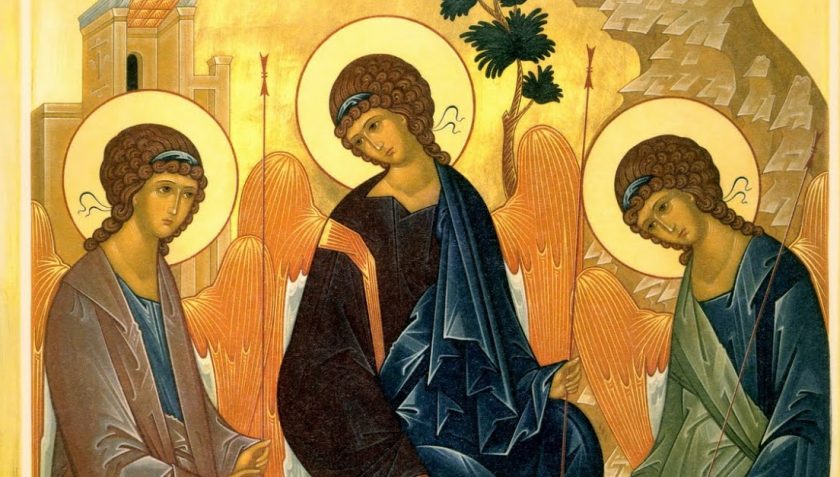
Today we celebrate the Solemnity of the Most Holy Trinity. The day’s Gospel is very brief, just three verses, yet it holds the very heart of the Christian message. There is a Tradition that says if we lost the entire Bible and were left with only John 3:16, we would still have kept the heart of the Gospel: the love of the Father, the sending of the Son, the new life offered in the Spirit.
It is also the Sunday on which we celebrate a mystery that no one will ever fully grasp. The word “Trinity” does not appear in the Bible, but it was consecrated by the Fathers of the Church (Tertullian was already using it) and made explicit by the Councils of Nicaea (325) and Constantinople (380). Yet the reality of the Trinity is entirely in the Bible, and is also in this small passage of Saint John: God (the Father) who loves, the only-begotten Son who is given, and the love (which is the Spirit) poured out in us. As Scott Hahn used to say, the doctrine of the Church is like a tree growing from birth: everything was there from the beginning, but it needed time to take shape. That is why the Lord himself commanded us to baptize “in the name of the Father, and of the Son, and of the Holy Spirit” (Mt 28:19), and the Holy Spirit, over the centuries, leads the Church into the fullness of truth.
We have chosen five points from the Gospel for this week’s meditation, which we share in the podcast and which you can watch with subtitles in your language.
1. “For God so loved the world that he gave…” (Jn 3:16a).
Both verbs are in the past: he loved and he gave. And it is true that the Son came only once in history. But if we stayed only with the verb tense, we would miss the essential. It is the same with creation: Genesis says that “In the beginning, God created the heavens and the earth” (Gn 1:1), and this is true, it happened at some moment in the past. But if God were to suspend creation for a single instant, everything would cease to exist. God continues creating, sustaining, giving being to all things at every moment.
In the same way, God continues loving and continues giving his Son. Jesus gives himself in the Eucharist, in the Word, in prayer, in the life of the Church. The “God who loved” of the past is also a “God who loves” of the present, now, at this very instant.
The book of Wisdom expresses this beautifully: “For you love all things that exist, and detest none of the things that you have made; for you would not have made anything if you had hated it” (Wis 11:24). It is also what one of Saint Thomas Aquinas’ five ways to reach God affirms: things exist because God creates them, and this is not an act in the past, it is a constant act. Like the hand pushing a stick that pushes a stone: if the hand stops pushing, the stone stops. God is the Hand that sustains all reality.
Therefore, perhaps the simplest and deepest exercise this week is to replace, in verse 16, the word “world” with your own name: “God so loved me, that he gave his only-begotten Son”. God’s love is universal, for he loves everyone, but it is also unique, individualized, unrepeatable. As the Fathers of the Church say, if there were a single person in the world, God would have given his Son for that one. For me. For you.
In the encyclical Deus Caritas Est, Pope Benedict XVI says that the Christian faith is not a series of rules nor an intellectual concept, it is a personal experience with Jesus Christ. Laws and norms only make sense when one understands the spirit of the rule, and this springs from the encounter with the person of Jesus. That is why, in the “hierarchy of truths of faith” of which the Second Vatican Council spoke, the first truth is this: “The true and only God, Father, Son, and Holy Spirit, reveals himself, reconciles himself, and unites to himself the men who turn away from sin” (CCC 234). Yes, we are sinners; but we are sinners loved and ransomed by God.
And note that in this single verse the whole Trinity is already there: God, who is the Father; the Love, who is the Spirit; and the only-begotten Son, Jesus. Three Persons, one God, at the heart of a single sentence.
2. “…his only-begotten Son” (Jn 3:16b)
The word “only-begotten” appears four times in the Fourth Gospel: in the Prologue (Jn 1:14, 18) and twice in this passage (Jn 3:16, 18). It is a term that carries enormous weight.
First, from a theological point of view: Jesus is the only Son because only he is of the same substance as the Father. He is God from God, Light from Light, begotten, not made, as the Greek Fathers would later make explicit in the Creed. He is the “true God and true man”. He is the “my Lord and my God” (Jn 20:28) of Thomas’ profession of faith. And it is of him that John’s Prologue says: “No one has ever seen God. The only-begotten Son, who is at the Father’s side, has made him known” (Jn 1:18).
Second, from an affective point of view, “only son” had a very strong connotation for the Israelite. Losing one’s only son was the worst of misfortunes. The prophet Amos, announcing the Day of the Lord, says: “I will make it like the mourning for an only son, and the end of it like a bitter day.” (Am 8:10). Zechariah and Jeremiah speak similarly. Thus we can measure the faith of Abraham called to offer Isaac, his only son. And the pain of that widow of Nain, whose only son Jesus raises (Lk 7:12). And, in turn, Jesus is also the only son of Mary.
Therefore, when the Father hands over the only-begotten Son, the gesture carries all the depth of love. We who are parents know what the loss of a child means. Imagine the weight of offering the only one, knowing what would come. This is God’s love for the world, and for each one of us.
3. “…that whoever believes in him should not perish but have eternal life” (Jn 3:16c).
Here there is an implicit truth that needs to come to light: we were condemned to death. Sin entered the world through one man and, with sin, death entered (cf. Rm 5:12). It was necessary that Jesus come, breaking the two barriers, that of nature (because he is true God) and that of sin (because he is true man, the new Adam, but obedient to the Father unto death), and open for us the way to eternal life. Death was conquered; faith in Christ makes us sharers in this victory.
Whoever believes in Jesus, though dying, will live. And there is something even simpler that we sometimes complicate: those who do not believe think this life is all there is. They lose an immense dimension, the dimension of eternity. They think that, in dying, they will disappear as before they were born. Yet, as Blessed Chiara Luce Badano used to say, we are born only once, but we live forever. Only this awareness of the eternity ahead of us is already, in itself, new life; faith already gives us eternal life.
That is why it is so striking that, for Saint John, “to sin” and “not to believe” are practically synonyms in the Fourth Gospel. If I do not believe in eternal life, I am already, to some extent, dead. There remains nihilism, pessimism, the “let us eat and drink, for tomorrow we die” (1 Cor 15:32) Saint Paul speaks of. And the apostle is categorical: if Christ has not been raised, we are of all people most to be pitied (cf. 1 Cor 15:19).
Dostoyevsky, in The Brothers Karamazov, portrays the inner conflict of modern man through three brothers, The oldest, impulsive and driven by passions; the middle brother, a tormented and rational intellectual; and the youngest, considered the hero of the story, known for his purity and faith. In reading him, we discover that we are a bit of all three: we have the impulsiveness of the first, the harshness of the second, and the innocence of the youngest. And it is Ivan, the middle brother, who concludes: “If there is no immortality of the soul, there is no virtue, which means that everything is permitted”. Faith is what brings order to this inner struggle, because it gives life back its definitive horizon: eternal life.
4. “For God sent the Son into the world, not to condemn the world, but in order that the world might be saved through him.” (Jn 3:17)
Jesus came to save. He came to seek the lost sheep. Implicit here is also the second coming, in which he will come as judge of the living and the dead; but the first coming, the Incarnation we celebrate at Advent, was entirely for our salvation. That is why he sat with tax collectors and sinners, going against the Pharisees and teachers of the Law, and answered: “Those who are well have no need of a physician, but those who are sick” (Mt 9:12). The problem is that, deep down, we always think we are the ones who are well.
When Jesus tells the parable of the hundred sheep, we want to place ourselves among the ninety-nine and not as the stray one. When he says he came for the sick, we never think we are the sick one. And so we miss the purpose of Jesus’ coming.
And a subtle trap is to say: “I have already accepted Jesus, I am already saved” and stop there. It is the temptation of the “Sola fide” of some evangelicals. If we isolate this verse, it really seems that believing is enough. But the whole of Scripture asks for more. The Letter of Saint James, which Luther wanted to remove from the Bible, says clearly: “faith without works is dead” (Jas 2:17). And Jesus himself, in Matthew 25:31-46, describes the final judgment by a single criterion, concrete love: I was hungry and you gave me food, I was thirsty and you gave me drink… It is worth reading this text once a week, just so as not to forget what truly leads us to Heaven.
It is also worth recalling an insight of Saint Thomas Aquinas: even if we had not sinned, Jesus would have become incarnate, because Jesus’ mission is not only to save us, it is also to reveal the Father to us, to reveal the Trinity to us. Without him, we would never come to know this truth of faith. Today, on the Solemnity of the Most Holy Trinity, it is good to remember this: Jesus is the priest, the altar, and the victim; he is the Shepherd and he is the Lamb; and he is, above all, the One who makes the face of the Father known to us.
5. “Whoever believes in him is not condemned, but whoever does not believe is condemned already, because he has not believed in the name of the only-begotten Son of God” (Jn 3:18).
Be careful not to read this verse as a definitive verdict. As long as there is life, there is salvation. “To condemn” here also carries the meaning of “to judge”, as in “do not judge, and you will not be judged” (Lk 6:37); some translations render it “he did not come to judge, but to save”. The condemnation spoken of is not the irremediable end of the unbeliever in this world, but the spiritual situation in which he already finds himself now through the refusal of faith.
Faith is one of the three theological virtues, along with hope and charity. The three sustain one another, forming as it were a trinity in the heart of the Christian. For this reason, the lack of faith can lead us to the two sins against hope which the Catechism (cf. 2091-2092) clearly distinguishes: despair and presumption.
Despair is to say: “I am already condemned anyway, there is no way out, and I throw in the towel”. The despairing person no longer tries, no longer prays, no longer seeks conversion. Presumption is the opposite: “I am already saved, I have accepted Jesus, I do not need to do anything else; and any sin or thing I do or fail to do will not change my salvation”. Both paralyze the path of holiness, and both spring, deep down, from the same lack of living faith.
That is why the Lord did not come to condemn us, but to sustain us on this journey. Salvation is a process, just as creation is a continuous process: God creates me at every instant, and Jesus saves me at every instant. It is up to me to cooperate with grace, every day, until the last day of life.
Steps for Lectio Divina
Reading (Lectio):
Take your Bible and read John 3:16-18 calmly. Read it a first time to become acquainted. Read it a second time letting the words touch you. Read it a third time underlining the word or phrase that most speaks to your heart today.
Meditation (Meditatio):
Replace, in the verse, the word “world” with your own name. Am I able to receive this personal, unique, individualized love that God has for me?
When I think of God, do I first think of a Father who loves me, or do I think of rules, obligations, fears? A great truth of the faith is “God loves me”. This is the foundation on which I can recognize my condition as a sinner without despair.
How do I live my faith in eternal life? Do I really believe that this life does not end, that there is eternity ahead of me? Does this change the way I live the present?
Am I aware that “faith without works is dead”? What concrete gestures of mercy, in the style of Matthew 25:31-46, are present (or absent) in my life?
Between despair and presumption, which of these two sins against hope do I tend toward more? How does living faith free me from both?
Prayer (Oratio):
Lord, we praise you and give you thanks for the beauty and richness of your Word, which is you yourself. You came to reveal to us the love of the Father for us, the love that is the Spirit poured into our hearts. We thank you, on this day, on this Solemnity of the Most Holy Trinity, which comes to dwell in us each time we receive you in the Eucharist: with you comes the Father, comes the Spirit, and the whole Trinity makes its dwelling in us.
Therefore, Lord, praised be you for your presence, for the indwelling with which you give yourself to us in every Eucharist. On this Sunday, we praise you for your love that sustains us every minute, for your creation that continues every instant, for so many graces we receive. We place in your hands, Lord, the intentions of our brothers and sisters who listen to us and who accompany us. Increase in us faith, hope, and love, which is you yourself. We ask all this through the intercession of the Most Holy Virgin. Hail Mary…
Contemplation (Contemplatio)
Remain in silence before the Lord. You do not need to say anything. Let the Trinity, who dwells in you by the grace of Baptism, pray in you. “The Spirit helps us in our weakness, for we do not know what to pray for as we ought; but the Spirit himself intercedes for us with sighs too deep for words” (Rm 8:26).
Action (Actio)
In these days the Shalom Catholic Community has celebrated the week of unity, and you can prolong it. Make a concrete gesture of unity: a reconciliation, a word of peace, an attention dedicated to someone who is alone. May this gesture be a visible sign of the unity of the Trinity in the midst of your loved ones.
See you next Saturday!
Shalom!
Watch the podcast on this Sunday’s Gospel, selecting the subtitles of your preference: https://youtu.be/KPsRFpn3NuQ